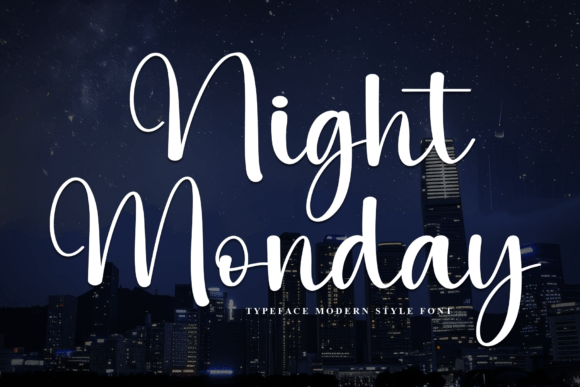
Night Monday: Evaluating a Modern Handwritten Script for Design Projects
In the landscape of digital typography, handwritten script fonts occupy a unique space between personal expression and professional utility. Night Monday is a modern handwritten script font that has gained attention for its ability to combine elegance with versatility. For designers, small business owners, and hobbyists selecting typefaces for specific projects, understanding the nuances of this font is essential. This evaluation explores the characteristics of Night Monday, its practical applications, and the considerations necessary to determine if it aligns with your creative goals.
Understanding the Aesthetic and Structure
Night Monday is defined by its flowing strokes and stylish handwritten feel. Unlike rigid serif or sans-serif fonts, it mimics the natural variation found in human handwriting. This organic quality brings warmth and sophistication to any creation, making it distinct from more mechanical typefaces. The font's structure relies on smooth connections between letters, creating a continuous visual rhythm that suggests fluidity and grace.
The design intent behind Night Monday appears to be a balance between legibility and artistic flair. While many script fonts sacrifice readability for style, this typeface maintains a level of clarity that allows it to function in both decorative and informational contexts. The "modern" descriptor in its classification suggests updated proportions and stroke weights that fit contemporary design trends, avoiding the overly ornate or dated looks associated with traditional calligraphy scripts.
Practical Applications and Use Cases
When evaluating a font, the primary question is often where it performs best. Night Monday is ideal for wedding invitations, branding, quotes, greeting cards, photography watermarks, apparel designs, and social media graphics. Its capacity to convey a personal touch makes it particularly effective for events and industries where emotional connection is paramount.
- Wedding and Event Stationery: The elegance of the script suits formal invitations, save-the-dates, and place cards, offering a sophisticated yet inviting tone.
- Branding and Logos: For businesses in lifestyle, beauty, or artisanal sectors, the font can serve as a primary logo element, establishing a brand identity that feels approachable and high-quality.
- Social Media and Marketing: In digital environments, the font works well for overlay text on images, quote graphics, and promotional banners where standing out visually is crucial.
- Crafting and Merchandise: The font is a great fit for Cricut and Silhouette projects, stickers, and product packaging. Its clean lines ensure that cutting machines can interpret the paths accurately, reducing weeding time and material waste.
For photographers, using Night Monday as a watermark provides a signature look that protects intellectual property without overpowering the image. Similarly, apparel designers can utilize the font for t-shirt prints or embroidery patterns, where the flowing nature of the letters adds dynamic movement to the fabric.
Technical Features and Accessibility
Beyond aesthetics, technical functionality plays a significant role in font selection. A notable feature of Night Monday is its encoded PUA (Private Use Area) character set. This means users can access special glyphs, ligatures, and alternate characters completely without additional design software. For users working in basic word processors or cutting machine software that may not support advanced OpenType features, this encoding ensures full access to the font's stylistic range.
This technical consideration lowers the barrier to entry for non-professional designers. It eliminates the need for complex plugin installations or specialized typography tools to achieve a polished look. However, users should verify compatibility with their specific operating systems and software versions, as PUA mapping can sometimes vary between platforms.
Benefits and Tradeoffs
Selecting Night Monday offers several benefits, primarily centered on its dual nature of being both personal and professional. It allows creators to inject humanity into digital designs, which can increase engagement and perceived value. The versatility of the font means a single license can cover diverse needs, from a corporate letterhead to a casual social media post.
However, there are tradeoffs to consider. As with most script fonts, legibility can decrease at smaller sizes or over long paragraphs. While Night Monday is designed for clarity, it is not intended for body copy in reports, legal documents, or dense informational brochures. Overuse of script fonts can also lead to visual fatigue; they are most effective when used sparingly as accents or headers rather than dominant textual elements.
Another consideration is the context of use. The warm and sophisticated vibe of Night Monday may not align with brands seeking a stark, industrial, or ultra-minimalist aesthetic. In sectors like technology, finance, or heavy industry, a geometric sans-serif might communicate stability and precision more effectively than a flowing script.
Decision-Making Insights
To determine if Night Monday is the right choice for your project, evaluate the following factors:
- Target Audience: Does your audience respond well to personal, hand-crafted aesthetics? If the goal is to evoke emotion, trust, or creativity, this font is a strong candidate.
- Medium of Delivery: Will the text be viewed on screens, printed on paper, or cut from vinyl? Night Monday performs well across these mediums, but ensure the resolution and size maintain the integrity of the thin strokes.
- Content Volume: Is the text short and impactful, or long and descriptive? Reserve this font for headlines, titles, and short phrases to maintain readability.
- Brand Consistency: Does the font complement existing visual assets? It should harmonize with your color palette, imagery style, and other typography choices.
When to Consider Alternatives
While Night Monday is a robust option for many scenarios, alternatives may be worth considering depending on specific constraints. If a project requires maximum legibility at very small sizes, such as ingredient lists on packaging or footnotes in a publication, a clean sans-serif or a highly legible serif font would be more appropriate. Similarly, if the design brief calls for a retro, grunge, or futuristic look, a script font may not provide the necessary stylistic alignment.
Additionally, users requiring extensive language support beyond standard Latin characters should verify the glyph coverage of Night Monday. Some specialized script fonts have limited character sets, which could restrict usage in multilingual projects.
Conclusion
Night Monday stands out as a versatile tool in the designer's toolkit, bridging the gap between casual handwriting and formal typography. Its natural handwritten look ensures that designs shine, whether for business, events, or personal creative projects. By understanding its strengths in branding, stationery, and crafting, while acknowledging its limitations regarding long-form text and specific industry aesthetics, users can make informed decisions. Ultimately, the value of Night Monday lies in its ability to add a human element to digital and physical creations, fostering a connection between the creator and the viewer.